Food as Medicine: How Dining Is Changing Senior Living
For a long time, dining in senior living had one job. Feed residents three meals a day. Keep the food hot. Keep families happy. If those things happened, the dining team had done its work.
That is no longer enough.
Today, the most forward-thinking communities see dining as something much bigger. What a resident eats can help manage chronic conditions. It can reduce the risk of falls. It can support brain health. It can even shape how connected and cared for a person feels in their home.
This is the idea behind food as medicine.
It is bigger than the kitchen
Food as medicine does not start and end with the chef. It happens when the dining team works alongside nurses, care staff, and life enrichment programs. It happens when everyone is looking at the same resident information and working toward the same goals.
One community put this into action during the COVID-19 pandemic. Residents were staying in their rooms. Falls were going up. The culinary team started adding fruit to water to make it taste better. The care and life enrichment teams helped get that water to residents all day.
A 60% drop in falls.
A simple change in the dining program led to a real clinical outcome.
Five things high-performing communities do differently
They cook from scratch. Fresh food is the starting point for everything else. It is better for the body and it opens the door for real clinical value.
They break down silos. Culinary, clinical, and care teams plan together. They do not wait for a problem to bring them to the same table.
They protect resident dignity. Every resident is different. Giving everyone the same meal because it is easier for staff, is not care. It is convenience. Meeting each person where they are is the standard.
They learn the person, not just the diet order. Knowing that a resident loves Cuban food, or celebrates a holiday with a specific dish, is just as important as knowing their sodium limit. That kind of knowledge builds real belonging.
They use technology to connect it all. When resident preferences, diet orders, allergen flags, and care notes all live in one system, the kitchen always has what it needs before a meal is served.
Where technology makes the difference
One of the biggest gaps in senior living dining is information. A new resident arrives on a Friday evening. The kitchen has no diet details. Staff are scrambling. This is not just a bad experience. It is a safety risk.
A connected dining platform changes that. The moment a resident is entered into the system, the kitchen is notified. Diet preferences, allergens, texture needs, and personal favorites follow the resident from day one.
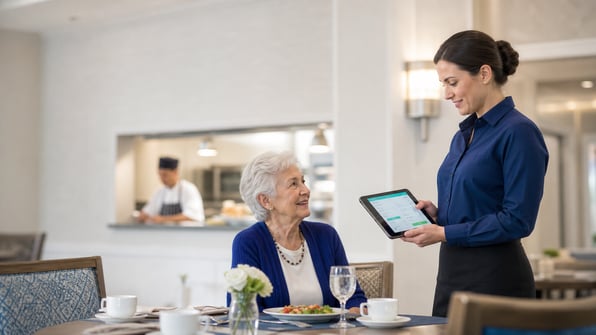
eMenuCHOICE is built for exactly this. It is a point-of-sale and dining management platform designed exclusively for senior living communities. It connects the kitchen to the care team so that every meal is safe, personal, and documented. When the information flows, the experience improves.
The bar has moved
Senior living dining is no longer just a hospitality service. It is a clinical function. Families expect more. Regulators are watching more closely. And residents, who are living longer with more complex needs, deserve more.
The communities that understand this will be the ones that families choose, and the ones that residents are proud to call home.
Food as medicine is not a trend. It is the new standard.
From principles to practice
Treating Dining as a Clinical Function Starts With the Right Foundation.
The five practices described above don't happen by accident. They happen when culinary, clinical, and care teams are working from the same information — at the right moment, for every resident. That's exactly what eMenuCHOICE was built to make possible.
FAQ
Common Questions
Answers to what senior living operators ask most about food as medicine and connected dining.
Food as medicine is the practice of using nutrition intentionally to support resident health outcomes — managing chronic conditions, reducing fall risk, and supporting cognitive function — rather than treating meals as a purely hospitality function.
Hydration is a leading factor in fall risk among older adults. Communities that coordinate between culinary and care teams to ensure consistent, appealing hydration throughout the day have seen significant reductions in falls — in one case, a 60% decrease after a simple change to the dining program.
The strongest programs share five traits: cooking from scratch, breaking down silos between culinary and clinical teams, honoring individual resident preferences, knowing residents personally beyond their diet orders, and using connected technology to keep all departments working from the same information.
Residents in senior living communities often have complex, overlapping health needs. What they eat directly affects medication effectiveness, chronic disease management, cognitive health, and quality of life — making dining decisions as consequential as any other aspect of care.
A connected dining platform integrates resident diet orders, allergen flags, personal preferences, and care notes into a single system accessible to both the kitchen and care teams. Without it, critical information — especially for new or transitioning residents — can fall through the cracks, creating safety risks and inconsistent experiences.