

What This Conversation Covers
For most of senior living's history, dining has been treated as a hospitality function. Keep residents fed. Keep families satisfied. Make sure the green beans aren't too soft. That bar has moved.
The residents moving into communities today come with chronic condition management requirements, dietary complexity that spans multiple care settings, and expectations shaped by decades of restaurant-level personalization. A dining program that isn't built to handle that complexity isn't just falling short on experience — it's creating clinical and operational risk.
This conversation brings together three senior living dining leaders to work through what that shift actually looks like on the ground. Moriah Bernhardt, VP of Life Enrichment at MorningStar Senior Living, Daniel Spicer, VP of Hospitality at Agemark Senior Living, and Shawn Pierce, Regional Corporate Culinary Consultant at Ebenezer, each bring a different vantage point — life enrichment, culinary leadership, and multi-community operations — to the same core question: what does it take to run a dining program that's genuinely built for the way senior living works today?
The conversation covers the telltale signs of a program that operates on staff convenience rather than resident need, the information breakdown that happens when dietary data doesn't move reliably from the care team to the kitchen, and what it looks like when communities get personalization right — not as a hospitality flourish, but as a clinical and cultural commitment. It closes on a thesis that each panelist arrived at independently: dining in senior living is crossing from hospitality into clinical, and the programs that recognize that shift will be the ones that succeed.
MorningStar Senior Living
With over 20 years in senior healthcare as a Licensed Professional Counselor and Art Therapist, Moriah specializes in holistic wellness, healthy aging, and innovative dementia engagement programs.
Agemark Senior Living
Daniel oversees culinary and life enrichment across Agemark's communities, having worked his way up from entry-level dining roles to senior hospitality leadership over more than a decade in the industry.
Ebenezer
Shawn brings more than two decades of culinary and hospitality experience, from restaurant kitchens to senior living dining leadership, to his work across the Ebenezer portfolio.

eMenuCHOICE
Sam spends his days talking with dining leaders across senior living — from dining directors to VPs — about the issues and frustrations they face day-to-day.
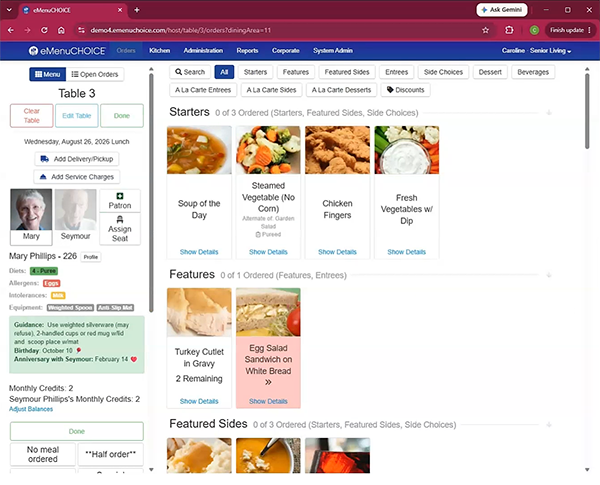
Here's What That Looks Like in eMenuCHOICE
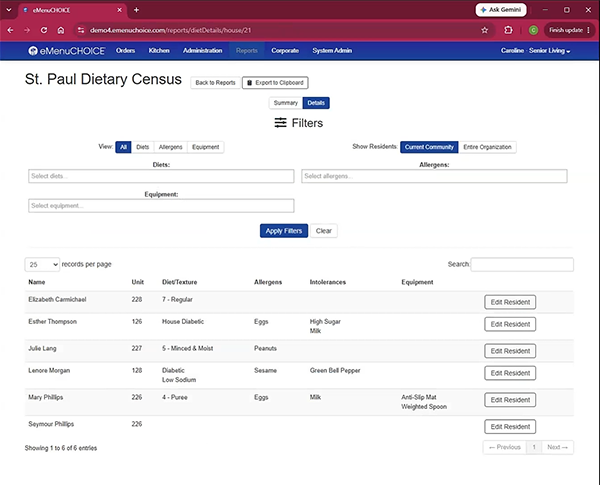
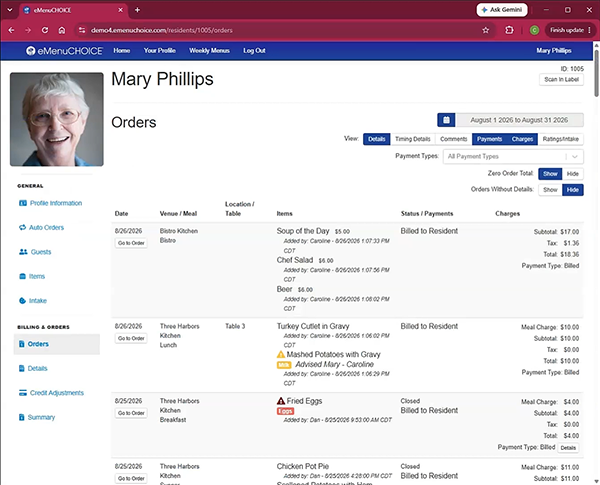
The panelists described what a well-integrated dining program needs to do. We followed one resident — Mary — through three scenarios to show exactly how that works.
Ready to see this in your community?
Request a DemoFrom the Q&A
How do you run food committees without them becoming a gripe session or creating unrealistic menu expectations?
In some communities we've moved away from open forums to a smaller committee of six or seven residents who represent the broader group. It prevents the meeting from becoming a free-for-all. We're also honest with residents about what's feasible. If they're asking for something that the POS data shows isn't ordered, we can show them that — it's hard to argue with numbers. And we've learned that sometimes residents just want to be heard. A sincere "I'm sorry, we'll do better" goes further than a defensive response or a scramble to overhaul the menu.
What does cross-departmental collaboration actually look like in practice — not in theory?
At MorningStar we call it the triad meeting — culinary, life enrichment, and sales and marketing come together at minimum monthly, sometimes weekly. It's not just for special events. It's for the small moments: a pop-up chef demo, a select group of residents helping shape the next menu cycle. New executive directors, life enrichment directors, and culinary directors are trained on this standard from day one. The more we communicate and plan together, the better the execution and the outcome for residents.
Food as Medicine Webinar
The complete 50-minute session with Moriah Bernhardt, Daniel Spicer, and Shawn Pierce — including the full Q&A discussion not covered in the highlight reel.
Watch the Full SessionFood as Medicine in Senior Living
A deep dive into what the food as medicine framework means for dining directors and executive directors — and how leading communities are putting it into practice.
Read the ArticleThe Five Pillars of Food as Medicine
A one-page visual summary of the five core principles that define a food as medicine approach to senior living dining.
View the InfographicHighlight Reel Transcript
Over the past decades, dining in senior living has been looked at as a hospitality function — to keep residents fed and keep families satisfied. But that bar is moving now.
We try to look at the mind and the soul and combine hospitality and health care together. We focus on not letting the health care side lose the hospitality side. While we have residents with specialized diets, we do everything we can to still give them a high level of culinary experience.
We tend to look at food as more than just three meals and nourishment — really about how we utilize that foundation to build healthy lifestyles and well-being in our communities. There's a purpose in our dining experience that goes beyond the three meals a day. It's where people connect the most socially. It's where people learn about new cuisines. We have this amazing opportunity to step beyond the traditional, institutional way of providing food in senior living.
When you go into different levels of care, you start to see the quality of the food and the experience decline. It's done out of convenience rather than for the overall experience of residents. The costs are going up as care levels increase. Why would the experience go down when residents are being asked to pay more? If anything, the experience should be going upward.
One of the things I think is really important is making sure we're meeting residents where they need to be met — not treating every resident the same. The dignity has to be at the forefront. Don't make every resident drink apple juice because it's easier for staff to fill up fifty glasses and pass them out. Ask the resident what they want.
I'll give you an example. We went into a community unannounced during breakfast service one morning. There was a big pan of chopped-up pancakes. I asked the chef what was going on, and he said, "We've got a couple of residents that need their food cut up, so I figured we'd just cut everybody's food up." They were putting a scoop of chopped-up pancakes on every resident's plate.
That is clearly something done for the convenience of the staff, not for the experience of the resident. A lot of things in senior living are done for the convenience of the staff, not for the betterment of the residents' experience.
One of the biggest challenges still in senior living — even though technology is starting to catch up — is there's still fragmentation with different systems. Having an integrated system that can bring all that information together is where the opportunity is. Starting from before a resident moves in, getting information about their preferences — even places they've traveled and cuisines they enjoy — and having that pushed all the way through as they move in and settle in to their new home.
With the introduction of AI, we now have a platform where when a resident is doing their intake interview, a person can sit there and just have a conversation — not try to figure out how to write everything down. AI captures that information and puts it into the resident profile.
A lot of this centers around getting information up front, which for us is tied to the technology side. We came from everything being done on paper. On weekends, we'd have someone roll in on a Friday evening and essentially be given no information. A paper slip would show up at our kitchen and everybody would be scrambling — sometimes with minutes to get a dish out, or the kitchen had already closed for dinner.
Now, the second a person is entered into our system, we're getting diet preferences, dislikes, and allergens — all entered immediately. We're notified before they've even hit the building. Having it all integrated means everybody gets that information. Staff can start placing orders in real time instead of being days behind, and issues like missed allergens or texture requirements don't fall through the cracks.
I was recently in a community where a server knew exactly what a resident's simple pleasures were. There was one resident celebrating her birthday, and the server got her her favorite dessert. That put a huge smile on her face. We can make such a big impact in those small ways.
We also have a community with a Jewish resident who wanted to do something for Passover. The chef came to her and said, "Teach me your recipe for matzah ball soup." They served it for everybody, along with the Passover Seder she conducted. That is what distinguishes great communities from the rest — that focus on preference and people's stories.
The community members who are moving in are expecting something completely different. If we want to be successful in running senior living communities, that shift needs to happen.
The headline today is that dining is crossing from hospitality into clinical.
See How eMenuCHOICE Handles Dietary Complexity
Watch how diet orders, allergens, and resident preferences are managed in real time — across every venue, every level of care.