

Free Resource · Senior Living Dining Software
Stop Guessing.
Start Evaluating.
Most dining software looks similar on a demo. The differences show up after go-live, when a dietary flag gets missed, a charge doesn't post, or your staff has to build workarounds for things the system was never designed to handle.
This guide gives you the framework to tell the difference before you sign anything.
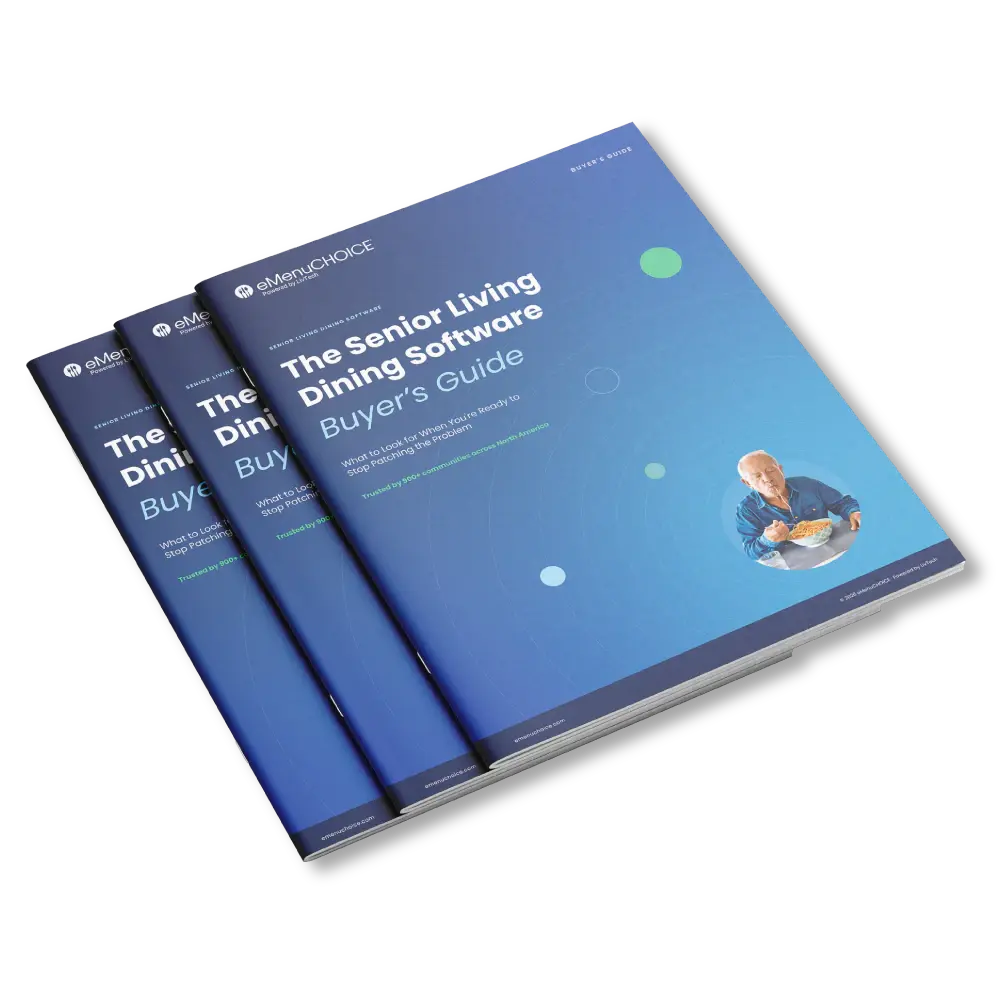
Download the Free Guide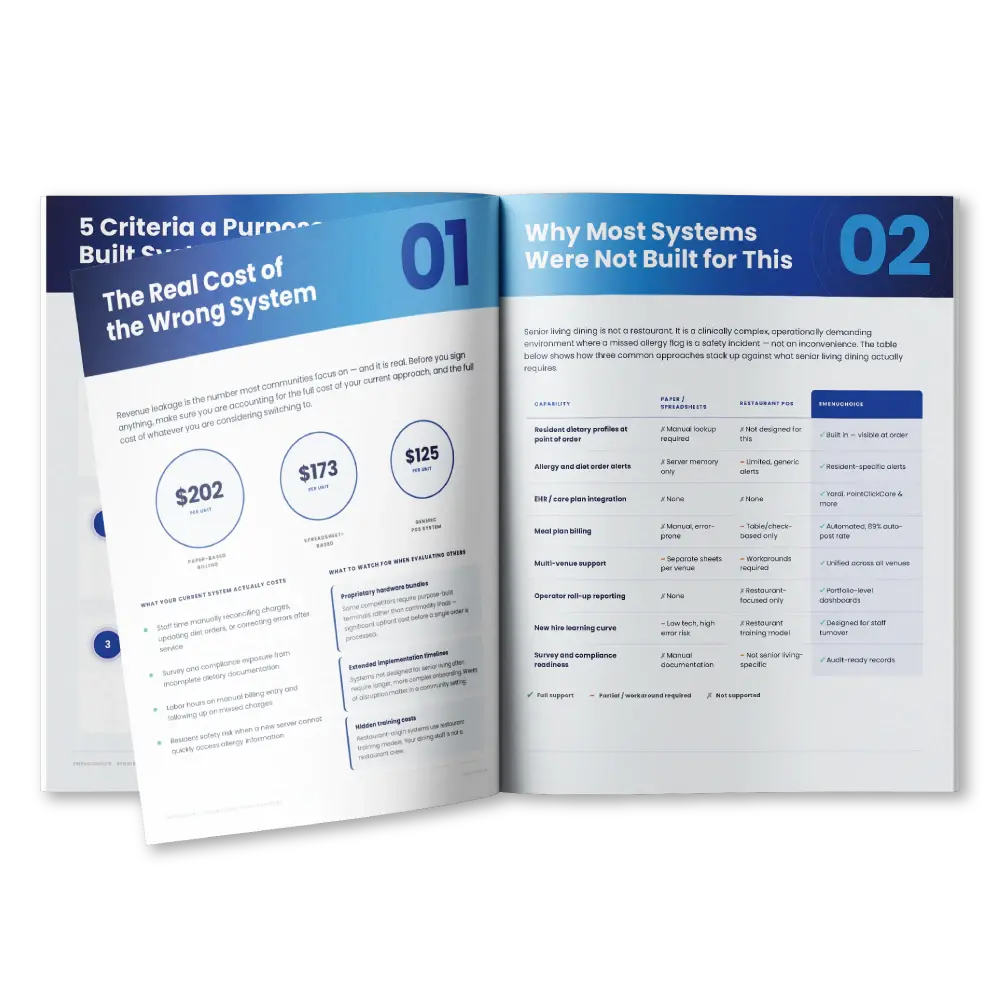
What You'll Get
A Practical Guide Built for How You Actually Make This Decision
You're not looking for a product brochure. You're trying to figure out which system will actually work in your dining room, with your staff, for your residents. That's what this guide is built around.
In 30 minutes or less, you'll have a clear framework for every vendor conversation you're about to have, and a business case you can bring to your executive director.
What's covered:
- The real cost of your current approach — beyond missed charges
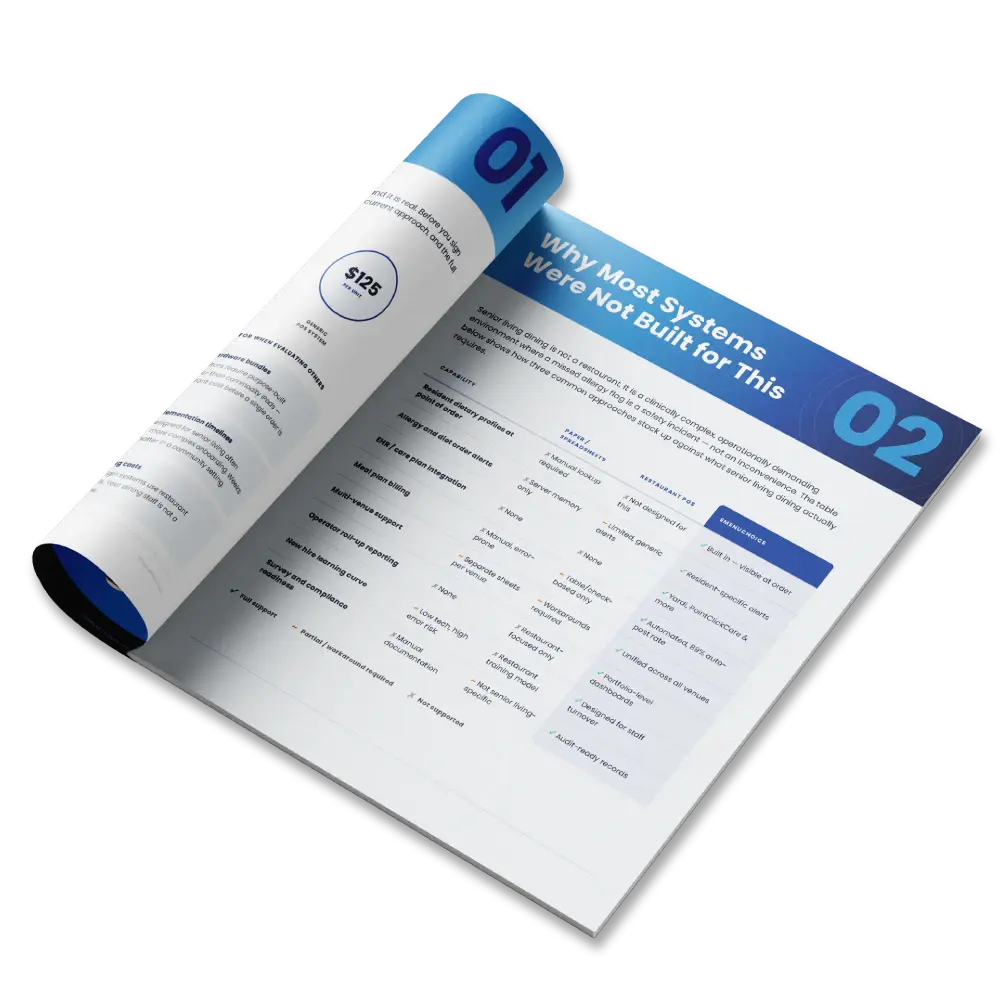
- Why most systems weren't designed for senior living dining, and how to spot the difference fast
- 5 capabilities a purpose-built system must have (and the questions to ask every vendor to verify them)
- A side-by-side comparison: paper and spreadsheets vs. restaurant POS vs. eMenuCHOICE
- Real numbers from communities that made the switch — with context, not just headlines
- How to structure the conversation with your executive director and make the business case stick
"Was this system built for how senior living dining works?"
The question every operator should ask first. This guide shows you how to get an honest answer.
The Category Problem
Most Dining Software Was Built for Restaurants. Yours Wasn't.
Senior living dining is not a restaurant operation. A missed allergy flag in a restaurant is an uncomfortable evening. In your dining room, it's a safety incident. A missed charge in a restaurant gets caught at close. In your community, it may never get caught at all.
The software category called "dining management software" includes everything from quick-service restaurant tools adapted for senior care, to systems built from the ground up for the dietary complexity, care plan integration, and billing requirements of communities like yours. Those are fundamentally different products. They don't look different on a feature list. They look very different on day 90.
The challenge is that most software demos are built to show you what a system can do in ideal conditions. This guide gives you the questions that reveal what it actually does in your conditions.
What to Look For
Five Things a System Built for Senior Living Does Differently
These are not features on a spec sheet. They are operational realities that either work in your environment or they don't. The guide covers all five in depth, including the specific questions to ask any vendor and what answers should concern you.
01Dietary Profiles Visible at the Point of Order
Every resident's texture modifications, allergies, and diet orders need to be on the screen the moment a server takes an order. Not in a binder at the nurses' station. Not something the server has to remember. If a server has to leave the table to verify a diet order, the system is not built for senior living.
02EHR Integration That Keeps Up With Diet Order Changes
A physician order changes on Monday. Your dining team needs to know by Tuesday's breakfast service. That only happens reliably when your dining system has a live integration with your EHR. Ask every vendor specifically which systems they connect to, and how frequently resident data syncs.
03Charge Capture That Doesn't Depend on Manual Entry
Ancillary charges, guest meals, and dining purchases need to flow to resident accounts without a staff member manually transferring them. Every manual step is a step where revenue can disappear. Communities using eMenuCHOICE auto-post 89% of charges to the resident ledger at point of service.
04Multi-Venue and Multi-Site Support That's Native, Not Bolted On
If your community has a bistro, a memory care dining room, and a main dining room, your system needs to handle all three without workarounds. If you're evaluating across multiple communities, you need roll-up reporting that shows dining performance across your portfolio without manual data consolidation.
05Training Built Around Staff Turnover, Not Restaurant Crews
High turnover is a reality in senior living dining. A system designed for restaurant operations assumes experienced staff who learn a system once. Your environment requires a system a new hire can use safely and competently within hours. The onboarding model matters as much as the feature set.
Free Download
Get the Complete Buyer's Guide
Fill out the form and we'll send the guide directly to your inbox. No sales call required.
Trusted by 900+ senior living communities across North America. Your information is never shared or sold.
Common Questions
What Dining Directors and Operations Leaders Ask Us
What's the difference between a restaurant POS and software built for senior living dining?
Restaurant POS systems are optimized for table turns, check splitting, and tip management. Senior living dining is a fundamentally different environment. Residents have dietary profiles, care plan restrictions, and allergy flags that need to be visible at every order. Charges need to post to resident accounts rather than close at a table. Staffing turnover is higher, which means onboarding speed matters more than advanced server features. A restaurant system can be configured to approximate these things, but the workarounds are where errors happen.
How do I know if my community is losing dining revenue, and how much?
The most common sources of leakage are guest meals that never get billed, ancillary charges that fall through between service and billing, and a-la-carte purchases that require manual transfer to the resident ledger. If your team is reconciling charges manually after service, or if you have no reliable way to audit what was ordered against what was billed, you almost certainly have leakage. The size of it depends on your billing method and community size. Communities using paper-based billing typically see the highest exposure.
Use the Revenue Leak Calculator at emenuchoice.com to estimate your specific number.
What EHR systems does senior living dining software typically integrate with?
Integration depth varies significantly by vendor. Look specifically for named integrations with the systems you use, not general claims about "EHR connectivity." eMenuCHOICE connects natively with 20+ platforms including PointClickCare, MatrixCare, Yardi, ALIS, Eldermark, ECP, August Health, and others. The more important question is sync frequency: a diet order that updates in your EHR needs to be reflected in your dining system before the next meal service, not on a nightly batch.
How long does implementation typically take, and what does it require from our team?
Implementation timelines vary widely. Restaurant-origin systems often require IT involvement, staff retraining on a restaurant model, and longer configuration periods because the system was not designed for your environment. Purpose-built senior living dining software should not require IT to go live. eMenuCHOICE typically onboards in 45 to 60 days with a $750 flat implementation fee and no proprietary hardware requirements — standard iPads are all you need. When evaluating vendors, ask specifically what is required from your team during onboarding and who manages the process.
How do I make the business case to my executive director?
The most effective approach is to ground the conversation in two numbers: what your current approach is costing in missed revenue, and what Year 1 recovery typically looks like. Section 6 of the guide walks through exactly how to structure this conversation, including the data points to bring, how to frame the labor and compliance costs that rarely appear in a typical ROI calculation, and what to say to a team that is resistant to a system change. Communities using eMenuCHOICE typically recover $713 or more per unit in Year 1 from revenue that was previously slipping through the cracks.
Next Step
Ready to See What It Looks Like in Your Community?
eMenuCHOICE is purpose-built for senior living dining. No restaurant workarounds. No proprietary hardware. No IT department required.
What Operators Are Seeing
The Numbers from Communities That Made the Switch
$84k
Year 1 ancillary revenue captured
The Blake at Miramar Beach · 118 units
89%
Of charges auto-posted to the resident ledger at point of service
"The residents know that we're looking out for them and making sure they're safe, making decisions that are in their best interests."
Daniel Novak
Corporate Director of Food and Beverage, All Seasons Senior Living